Publication Process
State Law Review: Jurnal Hukum Negara dan Pemerintahan is committed to maintaining high standards of academic quality, integrity, and transparency throughout its publication process. All manuscripts submitted to the journal are evaluated through a rigorous double-blind peer-review system and in accordance with internationally recognized principles of scholarly publishing and publication ethics.
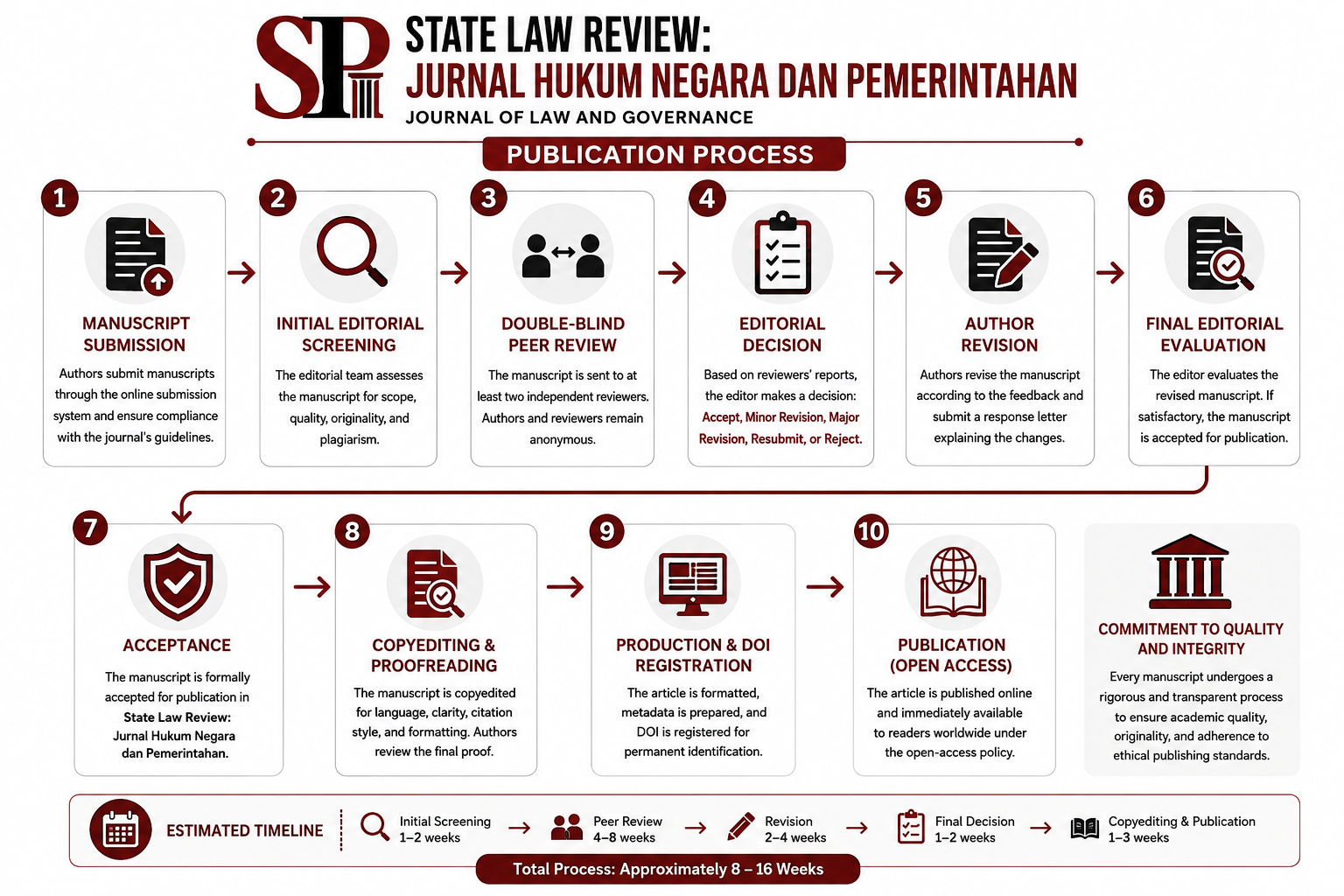
1. Manuscript Submission
Authors are required to submit their manuscripts through the journal’s online submission platform. Submissions must conform to the journal’s author guidelines, ethical policies, and formatting standards. Manuscripts should represent original scholarly work, must not have been previously published, and should not be under review by another publication.
2. Preliminary Editorial Assessment
Upon receipt, each manuscript undergoes an initial assessment by the Editorial Board to determine:
- Consistency with the journal’s focus and scope;
- Compliance with submission and formatting requirements;
- Originality, academic merit, and scientific contribution;
- Similarity screening and plagiarism verification.
Manuscripts that fail to satisfy these criteria may be declined at this stage or returned to the authors for necessary modifications before proceeding further.
3. Double-Blind Peer Review
Manuscripts that successfully pass the editorial assessment are forwarded to at least two qualified reviewers under a double-blind peer-review procedure, ensuring that neither authors nor reviewers are aware of each other’s identities.
Reviewers assess manuscripts based on:
- Originality and contribution to legal scholarship;
- Soundness of research methodology;
- Theoretical, doctrinal, or policy relevance;
- Quality and depth of legal analysis;
- Contribution to constitutional law, administrative law, governance, public policy, and related fields;
- Clarity, coherence, and scholarly significance.
4. Editorial Decision
Following the peer-review process, the Editor-in-Chief, based on the recommendations of reviewers, may issue one of the following decisions:
- Accept Submission;
- Minor Revisions Required;
- Major Revisions Required;
- Resubmit for Review;
- Reject Submission.
The corresponding author will receive the editorial decision together with reviewer comments and recommendations.
5. Revision Stage
Authors whose manuscripts require revision are expected to address all reviewer and editor comments comprehensively. Revised submissions must be accompanied by a detailed response outlining the modifications made.
Where deemed necessary, revised manuscripts may undergo an additional round of peer review.
6. Final Evaluation and Acceptance
After revisions have been completed satisfactorily, the manuscript is subjected to a final editorial evaluation. Manuscripts that meet the journal’s academic, ethical, and publication standards will receive formal acceptance for publication.
7. Copyediting and Proofreading
Accepted manuscripts enter the copyediting phase, during which language quality, grammar, citation format, references, layout consistency, and overall readability are reviewed and refined.
Authors may be contacted during this process to provide clarification or approve editorial changes. A final proof version will be sent to the authors for verification before publication.
8. Production and Online Publication
Following author approval, manuscripts proceed to production, including layout editing, metadata preparation, DOI registration, and online publication.
Published articles are assigned to the appropriate journal issue and made freely accessible under the journal’s open-access policy.
9. Post-Publication Management
All published articles remain permanently available through the journal website and digital preservation systems. Any corrections, withdrawals, retractions, or updates will be managed in accordance with the journal’s publication ethics policy and the guidelines established by COPE (Committee on Publication Ethics).
Estimated Publication Timeline
- Initial Editorial Assessment: 1–2 weeks
- Peer Review Process: 4–8 weeks
- Author Revision Stage: 2–4 weeks
- Final Editorial Decision: 1–2 weeks
- Copyediting and Publication: 1–3 weeks
Under normal circumstances, the entire publication process takes approximately 8–16 weeks, depending on manuscript quality, reviewer availability, and the extent of revisions required.