About the Journal
Focus and Scope
Global Justice Review: Jurnal Hukum Internasional (GJR) serves as an international scholarly platform for academics, researchers, legal practitioners, policymakers, diplomats, and members of international organizations to disseminate original research and conceptual studies in the fields of international law, international human rights law, international economic law, global governance, transnational legal studies, and contemporary issues affecting the international community.
The journal welcomes interdisciplinary, comparative, normative, and empirical studies related to:
- Public International Law;
- Private International Law;
- Comparative International Law;
- International Human Rights Law;
- International Humanitarian Law;
- International Criminal Law;
- International Trade and Investment Law;
- International Economic Law;
- International Environmental and Climate Change Law;
- Law of the Sea and Maritime Law;
- International Organizations and Global Governance;
- International Dispute Settlement and Arbitration;
- International Relations and Legal Diplomacy;
- Refugee, Migration, and Citizenship Law;
- Cyber Law and Digital Governance in International Contexts;
- International Business and Commercial Law;
- Regional Integration and International Cooperation;
- International Security and Peace Studies;
- Sustainable Development and Global Justice;
- Contemporary Issues in International and Transnational Law.
Submitted manuscripts must be original, unpublished, and not under consideration for publication in any other journal or publisher.
Peer Review Process
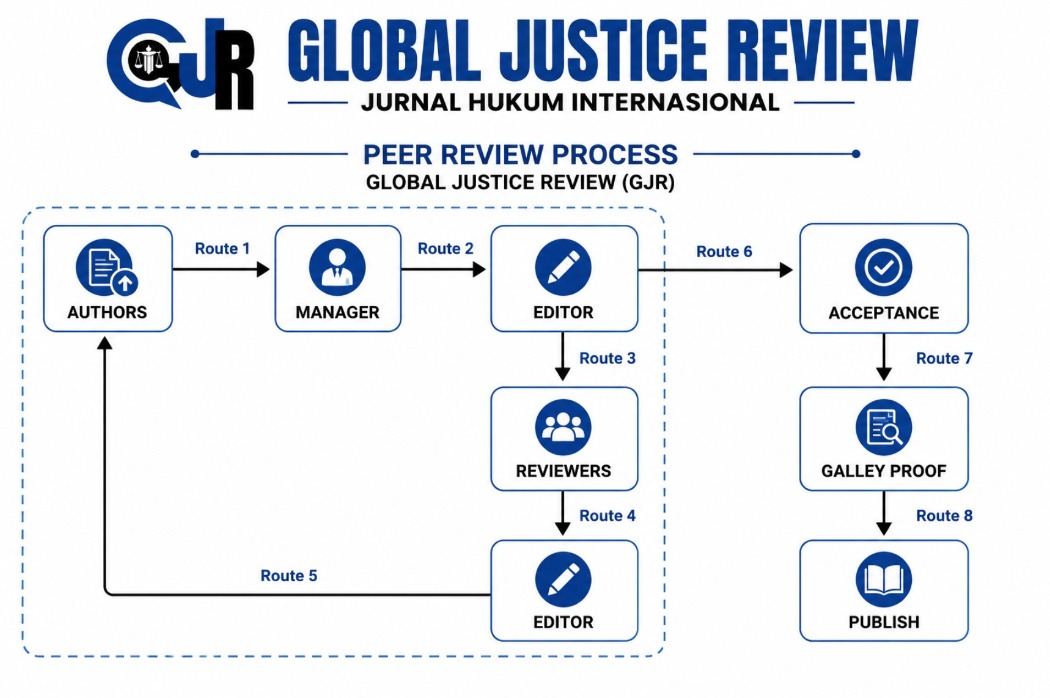
All papers are fully peer-reviewed. We only publish articles that have been reviewed and approved by highly qualified researchers with expertise in a field appropriate (at least two reviewers per article). We used double-blind peer-reviewing process. Detailed information about the flow for the manuscript submission (author) to the acceptance by editor is shown in the following figure.
In short, the steps are:
- Manuscript Submission (by author) (route 1)
- Manuscript Check and Selection (by manager and editors) (route 2). Editors have a right to directly accept, reject, or review. Prior to further processing steps, plagiarism check using Turnitin is applied for each manuscript.
- Manuscript Reviewing Process (by reviewers) (route 3-4)
- Notification of Manuscript Acceptance, Revision, or Rejection (by editor to author based on reviewers comments) (route 5)
- Paper Revision (by author)
- Revision Submission based on Reviewer Suggestion (by author) with the similar flow to point number 1. (route 1)
- If the reviewer seems to be satisfied with revision, notification for acceptance (by editor). (route 6)
- Galley proof and publishing process (route 7 and 8)
The steps point number 1 to 5 are considered as 1 round of the peer-reviewing process (see the grey area in the figure). The editor or editorial board considers the feedback provided by the peer reviewers and arrives at a decision. The following are the most common decisions:
- Accepted, as it is. The journal will publish the paper in its original form;
- Accepted by Minor Revisions, the journal will publish the paper and asks the author to make small corrections (let authors revised with stipulated time);
- Accepted by Major Revisions, the journal will publish the paper provided the authors make the changes suggested by the reviewers and/or editors (let authors revised with stipulated time);
- Resubmit (conditional rejection), the journal is willing to reconsider the paper in another round of decision making after the authors make major changes;
- Rejected (outright rejection), the journal will not publish the paper or reconsider it even if the authors make major revisions.
Publication Frequency
Journal Information and Policies
About the Journal
Global Justice Review: Jurnal Hukum Internasional (GJR) is a peer-reviewed academic journal published by PT Adikara Cipta Aksa. The journal serves as an international platform for the publication of high-quality research articles and conceptual studies in international law, transnational law, global governance, human rights, international organizations, and related areas of international legal studies. Global Justice Review is published twice a year, in June and December.
Open Access Policy
Global Justice Review is committed to the principle that unrestricted access to scholarly research enhances the global exchange of knowledge and contributes to the advancement of international legal scholarship.
All published articles are immediately and freely accessible without subscription fees, registration requirements, or access restrictions. Readers may read, download, copy, distribute, print, search, and link to the full texts of articles for lawful academic and non-commercial purposes.
Copyright Notice
All articles published in Global Justice Review: Jurnal Hukum Internasional (GJR) are licensed under the Creative Commons Attribution-NonCommercial-ShareAlike 4.0 International License (CC BY-NC-SA 4.0).
Under this license, users may read, download, copy, distribute, reproduce, and adapt the published material for non-commercial purposes, provided that appropriate credit is given to the original author(s) and source, and any derivative works are distributed under the same license.
Article Processing Charges (APCs)
Global Justice Review adopts a fully open-access publishing model and does not charge any fees to authors or readers.
Article Submission Fee
USD 0.00
Authors are not required to pay any fee for manuscript submission, editorial evaluation, or peer-review processing.
Article Processing Charges (APCs)
USD 0.00
Global Justice Review does not impose any publication fees, article processing charges, editorial handling fees, or page charges. All accepted articles are published free of charge.
Reader Access
All published articles are freely accessible worldwide. Academics, researchers, legal practitioners, diplomats, policymakers, international organizations, students, and the public may access, read, download, and share published articles without restrictions.
Plagiarism Policy
Global Justice Review maintains a strict policy against plagiarism, self-plagiarism, citation manipulation, and all forms of academic misconduct.
Authors must ensure that:
- Submitted manuscripts are original works;
- All sources and quotations are properly cited;
- The manuscript is not under consideration by another journal;
- Appropriate acknowledgment is provided for all referenced works.
Similarity Checking Process
All manuscripts undergo plagiarism screening through:
- Editorial assessment of originality and citation practices;
- Similarity checking using Turnitin or equivalent plagiarism detection software;
- Evaluation of similarity reports by the editorial team.
Manuscripts demonstrating plagiarism, excessive similarity, fabricated references, or unethical publication practices may be rejected immediately.
As a general guideline, the journal expects a similarity index of no more than 20%, excluding references, quotations, and standard legal terminology.
Archiving Policy
Global Justice Review is committed to preserving the scholarly record and ensuring long-term accessibility of published content.
1. Publisher's Digital Archive
All published content is securely preserved on servers managed by PT Adikara Cipta Aksa through regular backup procedures and security monitoring.
2. PKP Preservation Network (PKP PN)
The journal participates in the PKP Preservation Network (PKP PN) to ensure long-term digital preservation through distributed archival infrastructure.
3. Repository Preservation
Published articles may be archived and indexed through recognized repositories and scholarly databases, including:
- Garuda (Garba Rujukan Digital);
- Google Scholar;
- Dimensions;
- Crossref;
- Other relevant academic databases.
4. Author Self-Archiving
Authors are encouraged to deposit the final published version of their articles in institutional repositories, personal academic websites, and non-commercial scholarly repositories.
Authors should provide:
- Complete bibliographic information;
- DOI information;
- A link to the original publication in Global Justice Review.
5. Perpetual Access
Should the journal cease publication in the future, PT Adikara Cipta Aksa remains committed to preserving and maintaining permanent public access to previously published content through preservation networks and institutional archives.
Retraction, Withdrawal, and Correction Policy
Policy Statement
Global Justice Review is committed to maintaining the integrity, accuracy, and reliability of the scholarly record. Corrections, withdrawals, retractions, and other editorial notices may be issued when necessary in accordance with the principles of the Committee on Publication Ethics (COPE).
Article Retraction
An article may be retracted when significant violations of publication ethics are identified, including:
- Plagiarism;
- Self-plagiarism;
- Duplicate publication;
- Fabricated or falsified data;
- False authorship claims;
- Serious ethical misconduct;
- Significant errors affecting the reliability of the research.
When an article is retracted:
- A formal Retraction Notice will be published;
- The original article will remain accessible for transparency;
- The PDF version will be clearly marked as “Retracted”;
- Readers will be informed of the reasons for retraction.
Article Withdrawal
Withdrawal may occur before publication when:
- A manuscript has been submitted in error;
- Duplicate submission is identified;
- Ethical concerns arise;
- Authors request withdrawal for valid reasons.
Article Correction
Corrections may be issued when:
- Minor errors affect interpretation;
- Author information requires revision;
- Important information requires clarification;
- Publishing errors are identified.
Corrections may take the form of:
- Publisher Correction (Erratum);
- Author Correction (Corrigendum);
- Addendum.
Article Removal
In exceptional circumstances, an article may be removed if it:
- Violates applicable laws;
- Contains defamatory content;
- Infringes intellectual property rights;
- Is subject to a court order;
- Creates serious legal or security concerns.
Article Replacement
Where a published article contains substantial errors affecting scholarly use, authors may request replacement with a corrected version. A replacement notice will be published together with a record of the changes made.
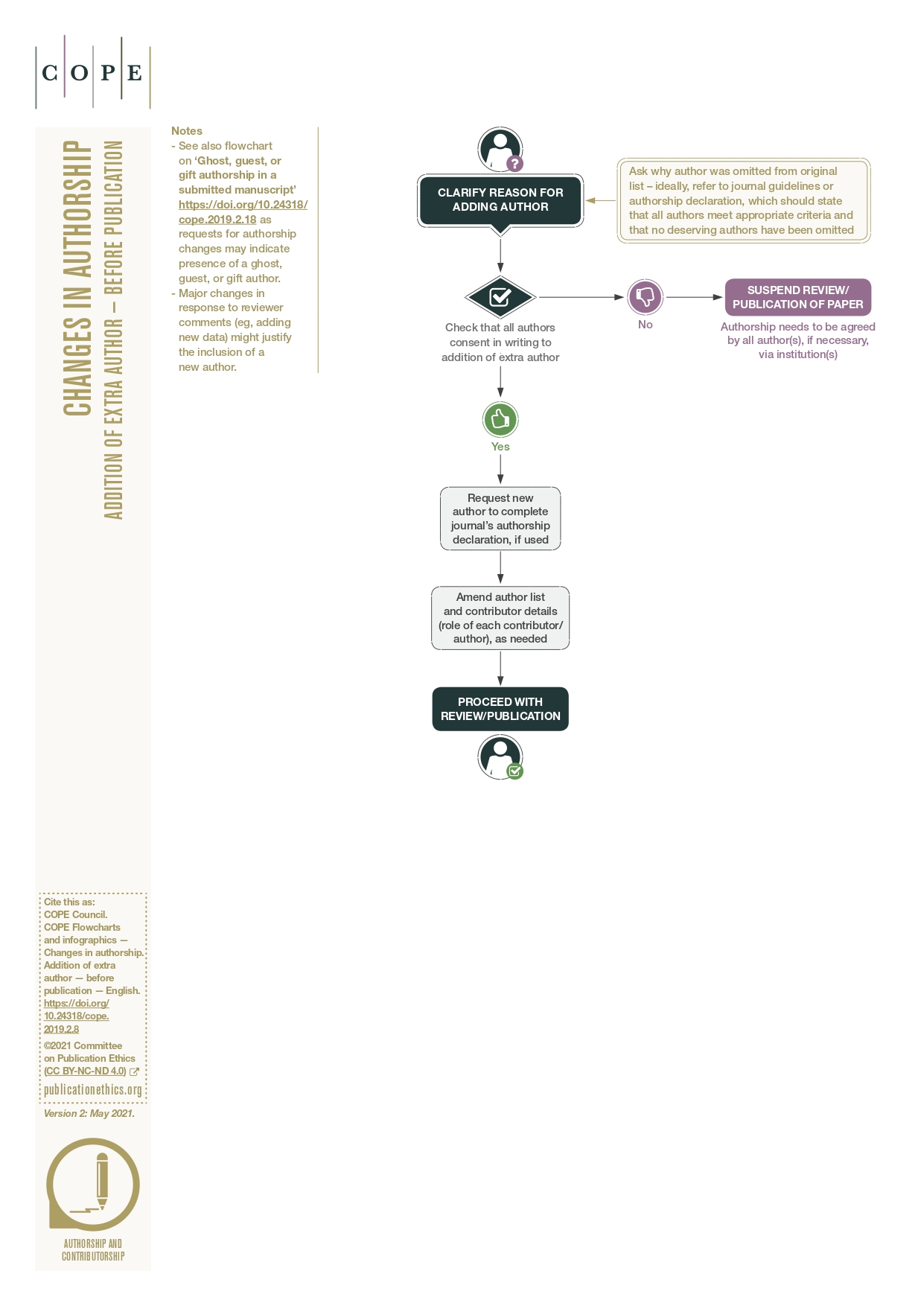
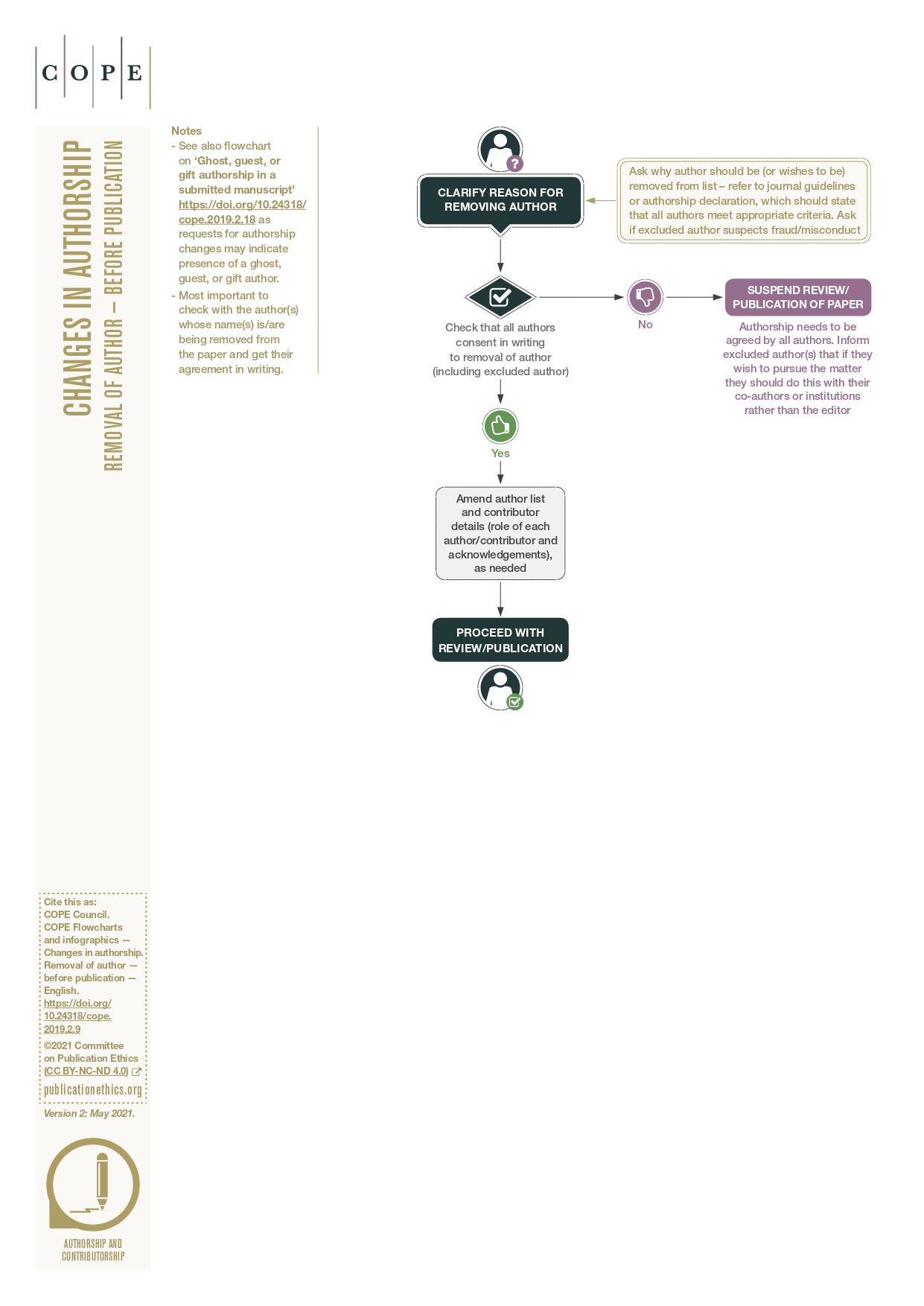
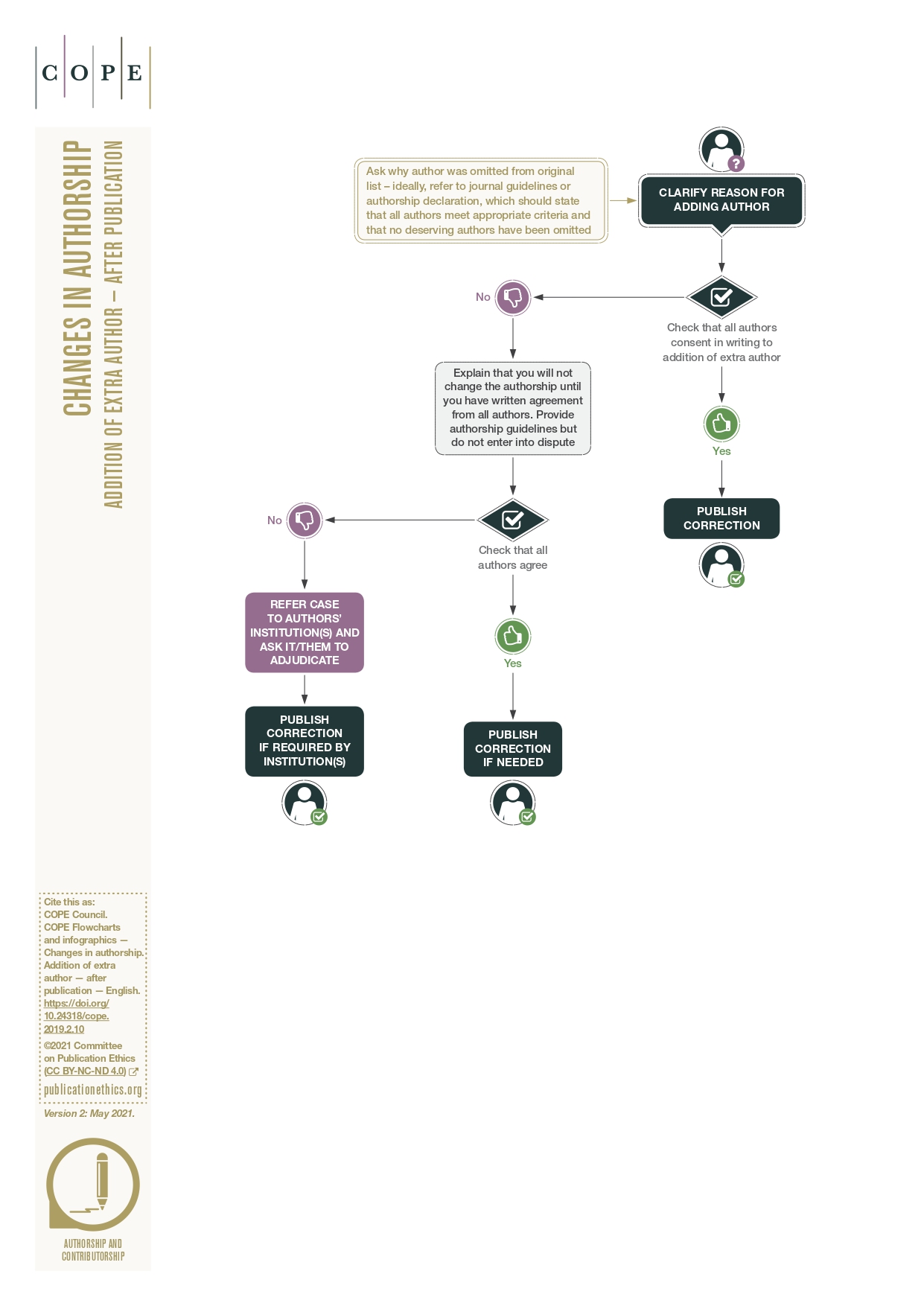
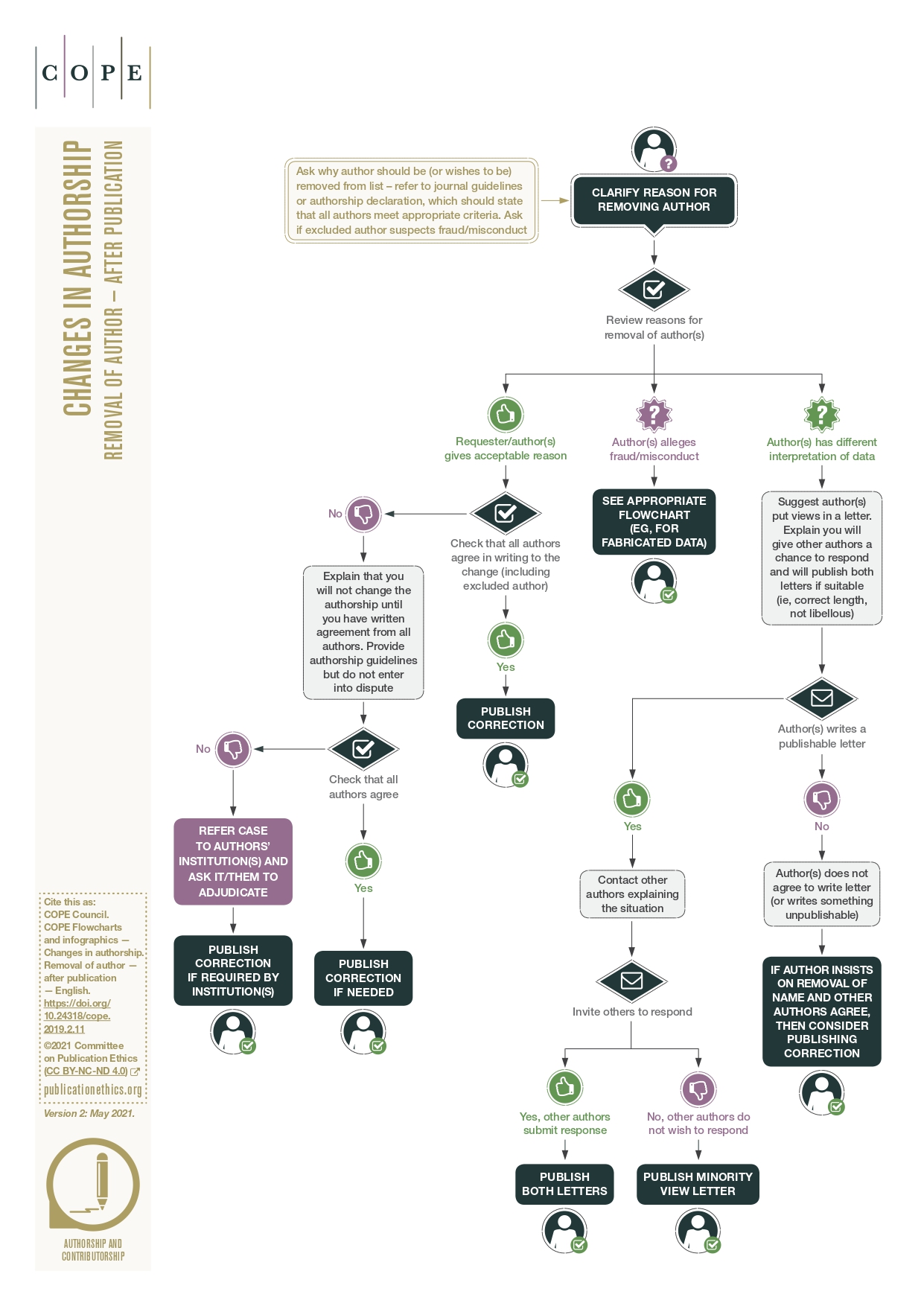
Changes in Authorship