Publication Process
Al-Muqārana: Journal of Comparative Islamic Law follows a rigorous and transparent publication process to ensure the quality, originality, and academic integrity of all published articles. The journal applies a double-blind peer-review system and adheres to internationally recognized standards of scholarly publishing.
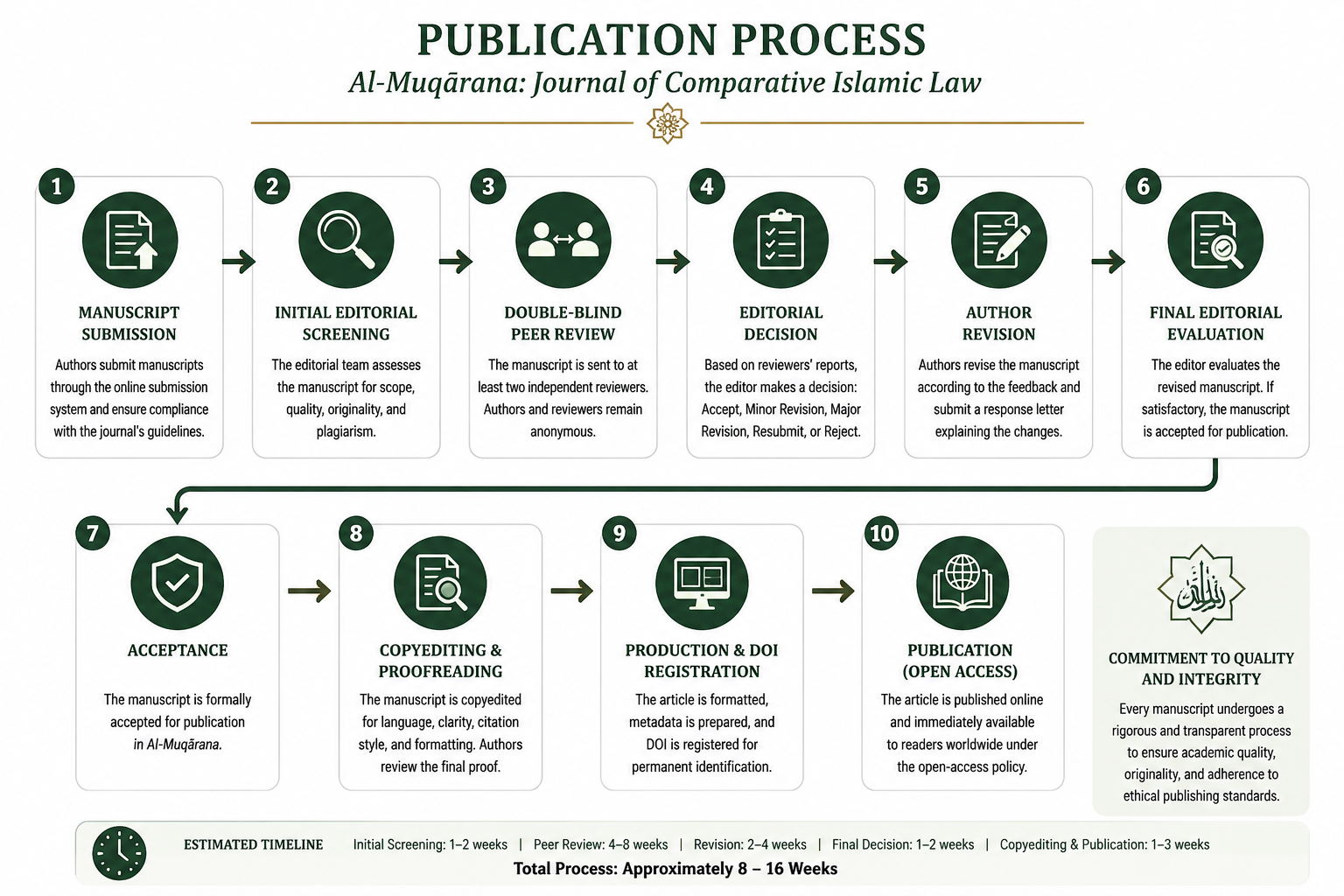
1. Manuscript Submission
Authors submit manuscripts through the journal’s online submission system. Submitted manuscripts must comply with the journal’s author guidelines, ethical standards, and formatting requirements. Manuscripts must be original, unpublished, and not under consideration by another journal.
2. Initial Editorial Screening
Upon submission, manuscripts undergo an initial evaluation by the Editorial Team to assess:
- Relevance to the journal’s aims and scope;
- Compliance with submission guidelines;
- Academic quality and originality;
- Similarity and plagiarism screening.
Manuscripts that do not meet these requirements may be returned to the authors for revision or rejected without external review.
3. Double-Blind Peer Review
Manuscripts that pass the editorial screening are assigned to at least two independent reviewers through a double-blind peer-review process, in which the identities of both authors and reviewers remain anonymous.
Reviewers evaluate:
- Originality and novelty;
- Methodological rigor;
- Theoretical and legal contribution;
- Quality of analysis and argumentation;
- Relevance to comparative Islamic law and related fields;
- Clarity of presentation and scholarly significance.
4. Editorial Decision
Based on reviewers’ recommendations, the Editor-in-Chief may issue one of the following decisions:
- Accept Submission;
- Minor Revisions Required;
- Major Revisions Required;
- Resubmit for Review;
- Reject Submission.
The editorial decision is communicated to the corresponding author together with reviewer comments.
5. Manuscript Revision
Authors are required to revise their manuscripts in accordance with reviewer and editor recommendations. Revised manuscripts must be accompanied by a response letter explaining how the comments have been addressed.
Where necessary, revised manuscripts may be returned to reviewers for further evaluation.
6. Final Acceptance
After all revisions have been satisfactorily completed, the manuscript undergoes a final editorial assessment. Manuscripts that meet the journal’s academic and ethical standards will receive formal acceptance for publication.
7. Copyediting and Proofreading
Accepted manuscripts proceed to the copyediting stage, where language, grammar, citation style, formatting, and consistency are reviewed. Authors may be contacted for clarification during this stage.
The final proof is sent to authors for approval prior to publication.
8. Production and Publication
Following author approval, the manuscript enters the production stage, including layout editing, metadata preparation, DOI registration, and online publication.
Articles are published in the current issue and become immediately available under the journal’s open-access policy.
9. Post-Publication
Published articles remain permanently accessible through the journal website and digital preservation systems. Corrections, retractions, or updates will be handled in accordance with the journal’s publication ethics policy and COPE guidelines.
Estimated Timeline
- Initial Editorial Screening: 1–2 weeks
- Peer Review Process: 4–8 weeks
- Revision Process: 2–4 weeks
- Final Editorial Decision: 1–2 weeks
- Copyediting and Publication: 1–3 weeks
The total publication process generally ranges from 8 to 16 weeks, depending on the quality of the submission, reviewer availability, and the extent of revisions required.